
6G Technology: When Is It Coming? Complete Guide to the Future of Wireless
If you’re wondering about 6G technology and when it’s actually going to arrive, you’re not alone. While most of us are still getting comfortable with 5G networks, tech companies and researchers worldwide are already deep into developing the next generation of wireless connectivity. The buzz around 6G technology isn’t just hype—it represents a fundamental shift in how we’ll connect, communicate, and interact with the digital world over the next decade.
I remember when 4G first rolled out, and everyone thought it was impossibly fast. Now we’re streaming 4K videos without a second thought. The leap to 6G promises to be even more transformative, bringing speeds up to 100 times faster than 5G, along with capabilities we can barely imagine today.
In this comprehensive guide, we’ll explore everything you need to know about 6G technology: realistic timelines for deployment, the revolutionary features it will bring, how it compares to current 5G networks, and what this means for your everyday tech experience. Whether you’re a tech enthusiast or just curious about what’s coming next, you’ll find practical insights that cut through the technical jargon.

What Exactly Is 6G Technology?
Before diving into timelines, let’s clarify what we mean by 6G technology. Simply put, it’s the sixth generation of wireless communication standards that will eventually replace 5G. But it’s much more than just a speed upgrade.
6G technology is being designed to operate at terahertz frequencies (100 GHz to 10 THz), compared to 5G’s millimeter wave frequencies. This fundamental shift enables data transmission speeds theoretically reaching 1 terabit per second—that’s about 8,000 times faster than what most 5G networks deliver today. Imagine downloading an entire 4K movie in less than a second, or more practically, enabling real-time holographic communications.
What makes 6G truly revolutionary isn’t just speed. Researchers are building in native support for artificial intelligence, ultra-precise positioning (accurate to within centimeters), and near-zero latency. We’re talking about response times under one millisecond, which opens doors for applications like remote surgery, autonomous vehicle coordination, and immersive extended reality experiences that feel completely natural.
The technology will also integrate satellite communications seamlessly, meaning you’ll have consistent high-speed connectivity whether you’re in a city center or hiking in remote wilderness. For those interested in how AI tools and chatbots will evolve, 6G will provide the infrastructure for truly responsive, intelligent systems.
When Will 6G Technology Actually Launch?
Here’s the realistic timeline based on current industry roadmaps and international development efforts. The short answer: commercial 6G networks are expected to launch around 2030, with full global deployment likely extending into 2035.
This might seem far away, but wireless technology development follows predictable patterns. Each generation takes approximately 10 years from initial research to commercial deployment. 5G standards were finalized in 2020, with rollout continuing through 2025. Following this pattern, 6G is right on track.
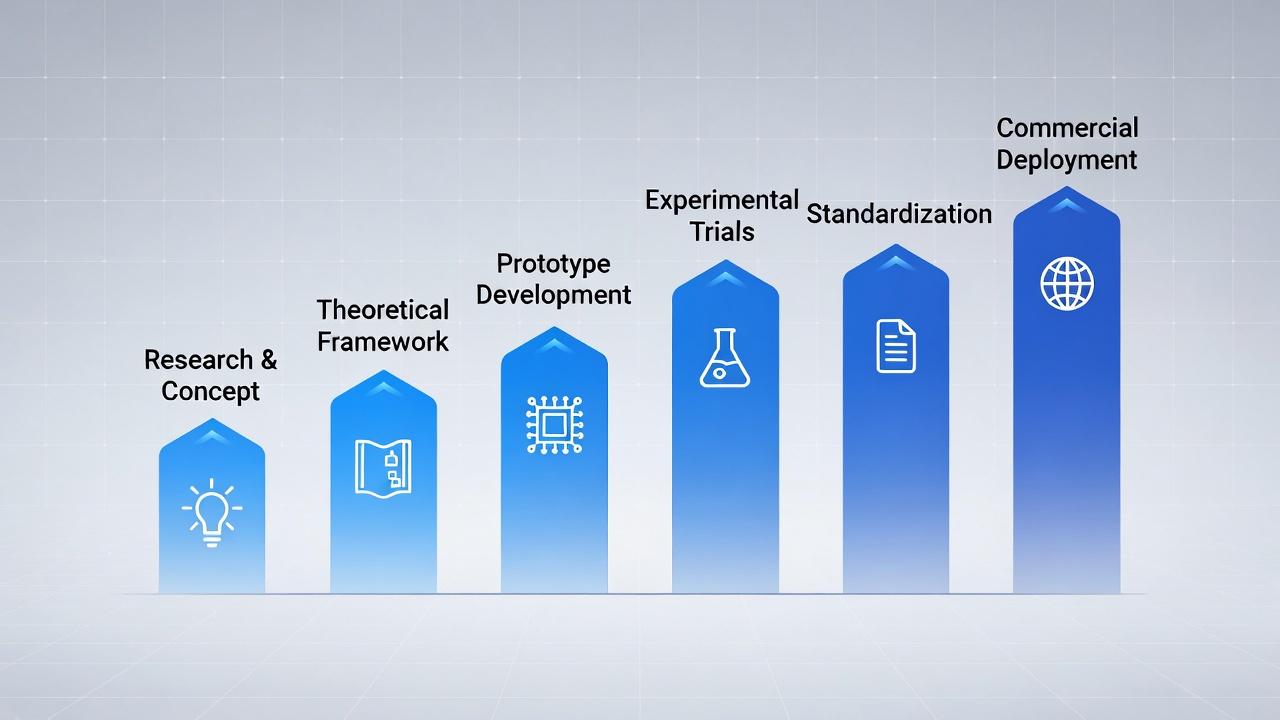
Current development phases:
- 2025-2027 (Research Phase): Companies like Samsung, Nokia, Huawei, and research institutions are conducting fundamental research, testing terahertz communications, and developing prototype systems. Standards organizations are beginning preliminary discussions about specifications.
- 2027-2029 (Standardization Phase): The International Telecommunication Union (ITU) and 3GPP will work on finalizing technical standards and specifications. Early trials and pilot programs will begin in select locations, primarily in South Korea, China, Japan, and parts of Europe.
- 2030-2032 (Initial Deployment): First commercial 6G networks will launch in major tech-forward cities. Early adopters will experience the technology through specialized devices and applications. Expect limited coverage similar to early 5G rollouts.
- 2033-2035 (Broader Rollout): Mainstream deployment across developed nations, with 6G-enabled smartphones and devices becoming readily available. Infrastructure buildout will continue, expanding coverage to suburban and rural areas.
Keep in mind that these timelines can shift based on technological breakthroughs, regulatory decisions, and global economic factors. Some countries may see 6G earlier or later depending on their infrastructure investments and policy priorities.
How 6G Compares to 5G: The Real Differences
You might be thinking, “My 5G phone already feels fast enough. Do we really need 6G?” It’s a fair question, and the answer reveals why this technology matters beyond just speed improvements.
5G brought significant improvements over 4G: peak speeds around 10-20 Gbps, latency around 1-10 milliseconds, and the ability to connect about 1 million devices per square kilometer. These capabilities enabled better mobile video streaming, improved gaming experiences, and initial steps toward smart city applications.
6G technology takes everything to entirely new levels. We’re looking at peak speeds of 1 Tbps (100 times faster), latency below 1 millisecond, and support for 10 million devices per square kilometer. But the real differences go deeper than these numbers suggest.
The most significant distinction is that 6G will have artificial intelligence built into the network itself. Rather than just carrying data, 6G networks will intelligently optimize connections, predict bandwidth needs, and adapt to changing conditions in real-time. This means your experience will be consistently excellent, whether you’re in a crowded stadium or a quiet library.
Another major difference: 6G will integrate multiple spectrum bands seamlessly, including satellite connections. Your device will automatically switch between terrestrial and satellite networks without you noticing. This solves one of 5G’s biggest limitations—coverage gaps in rural and remote areas.
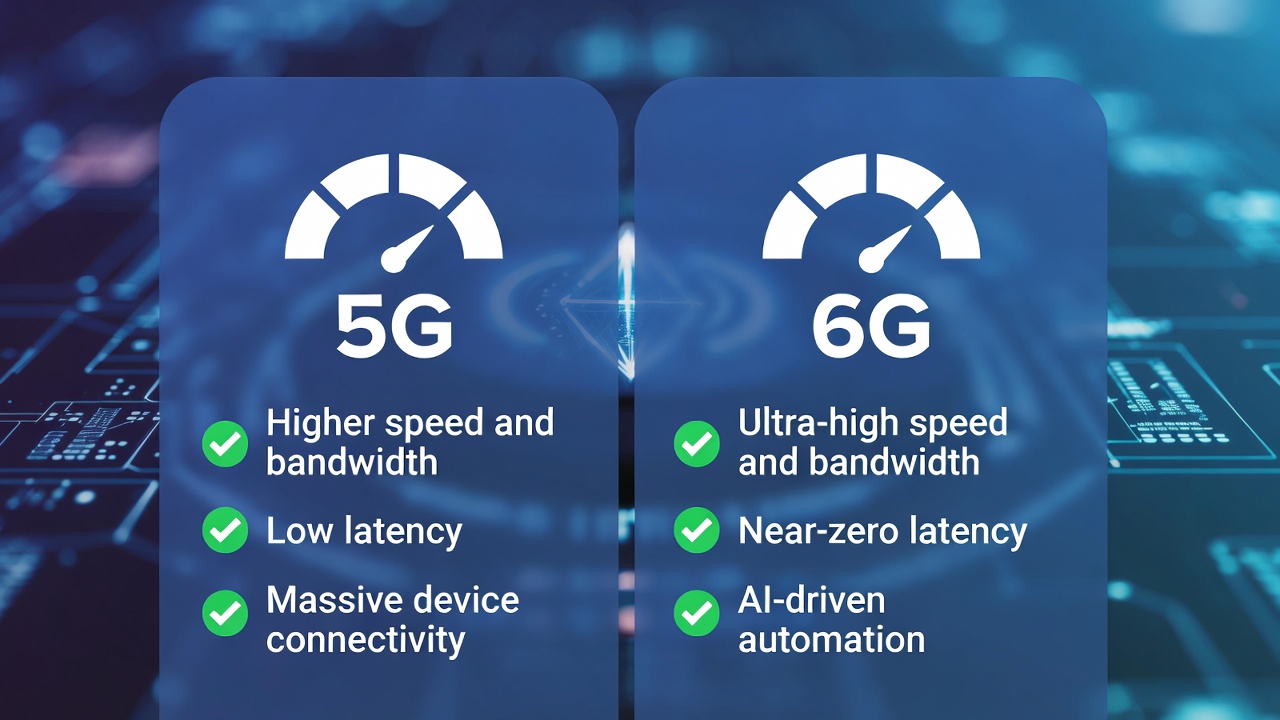
For applications, 5G enabled high-quality video calls and mobile gaming. 6G will enable holographic telepresence where you feel like you’re in the same room as someone across the globe. 5G helped autonomous vehicles communicate with traffic systems. 6G will coordinate entire fleets of vehicles with perfect synchronization, dramatically improving safety and traffic flow.
If you’re interested in how this will affect home automation systems, 6G will make your smart home exponentially more responsive and capable, with devices that anticipate your needs before you express them.
Revolutionary Applications Enabled by 6G
Understanding what 6G technology will actually do for us helps clarify why the investment and development effort makes sense. These aren’t science fiction concepts—they’re practical applications already in early development.
Holographic communications: Imagine video calls where life-size, three-dimensional representations of people appear in your room. 6G’s bandwidth and low latency make this possible for everyday use, not just expensive corporate setups. Business meetings, family gatherings, and education will fundamentally change when physical presence becomes optional.
Digital twin cities: Urban planners will create real-time virtual replicas of entire cities, with every building, vehicle, and infrastructure element represented. This enables sophisticated simulations for traffic management, emergency response planning, and environmental monitoring. The massive data requirements make this impossible with current networks.
Advanced healthcare: Doctors will perform surgeries remotely with haptic feedback that lets them “feel” what they’re doing through robotic instruments thousands of miles away. The sub-millisecond latency ensures no dangerous delays between surgeon actions and robot response. Continuous health monitoring through body-area networks will detect medical issues before symptoms appear.
Immersive extended reality: Current VR and AR experiences often suffer from lag and limited detail. 6G will deliver seamless integration of digital and physical worlds, with graphics quality matching what you see naturally and zero motion sickness from delays. This transforms education, training, entertainment, and how we work.
Ubiquitous sensing and intelligence: Everything from infrastructure to consumer products will have embedded sensors communicating constantly. Buildings will monitor their own structural health. Agricultural fields will optimize water and nutrient delivery plant by plant. Warehouses will track every item automatically without human intervention.
For gamers wondering how this affects their experience, check out developments in PC and console gaming where 6G will enable cloud gaming that’s indistinguishable from local hardware, with no latency or quality compromises.
Technical Challenges Facing 6G Development
While the promises of 6G technology sound incredible, significant hurdles remain before these visions become reality. Understanding these challenges helps set realistic expectations about what we’ll actually see in 2030 and beyond.
The biggest technical challenge is working with terahertz frequencies. These extremely high frequencies can carry massive amounts of data but have severe limitations. They travel only short distances and are easily blocked by walls, rain, foliage, and even humidity in the air. Current 5G millimeter wave technology faces similar issues, but 6G’s frequencies are even more problematic.
Engineers are exploring several solutions: extremely dense networks of small cells (potentially every 10-50 meters in urban areas), intelligent reflecting surfaces that bounce signals around obstacles, and hybrid systems that seamlessly switch between different frequency bands. Each approach adds complexity and cost to network deployment.
Energy consumption poses another major concern. Processing terabit-per-second data streams requires significant power. For mobile devices, this threatens battery life. For network infrastructure, it raises environmental and operating cost questions. Researchers are developing new materials, more efficient antennas, and smarter power management systems, but achieving practical energy efficiency remains an active challenge.
The artificial intelligence integration that makes 6G so promising also creates challenges. Training AI models for network optimization requires massive computational resources. Ensuring these systems make appropriate decisions across billions of devices and countless scenarios demands extensive testing and refinement.
Regulatory and spectrum allocation issues complicate matters further. Countries must coordinate on frequency assignments to avoid interference. International standards must be agreed upon while different nations compete for technological leadership. The geopolitical dimensions of 6G development are as complex as the technical ones.
Who’s Leading 6G Development Right Now?
Several countries and companies are racing to establish leadership in 6G technology, with significant implications for global tech influence and economic advantages. Here’s where things stand as of 2025.
China has made 6G a national priority, with substantial government funding flowing into research. Chinese companies like Huawei and ZTE are conducting extensive trials and have published numerous patents related to terahertz communications and AI-integrated networks. China launched a 6G test satellite in 2020 and aims to be first to market with commercial services.
South Korea is another frontrunner, building on its success with early 5G deployment. Samsung leads much of the corporate research, with the Korean government funding university collaborations and standards development work. South Korea has stated ambitions to launch 6G services by 2028-2030, ahead of global competitors.
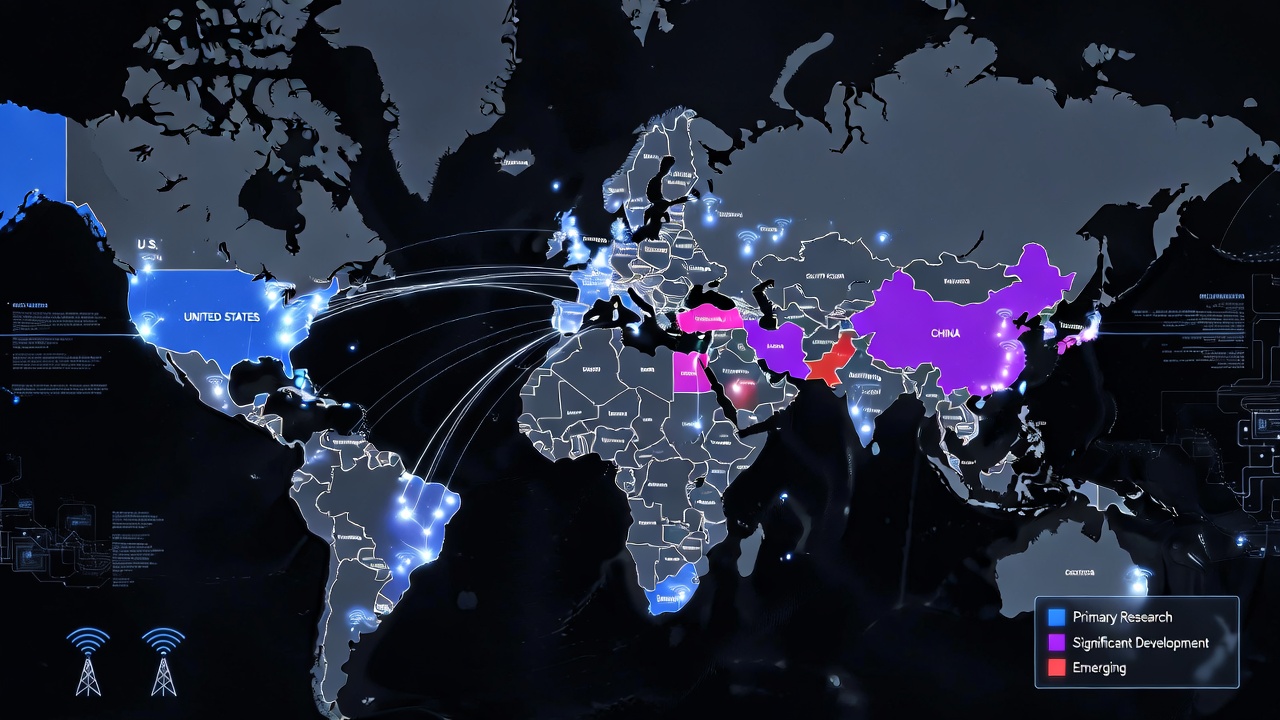
Japan has established a comprehensive 6G roadmap with collaboration between NTT Docomo, Sony, and academic institutions. The Japanese approach emphasizes energy efficiency and integration with satellite communications, reflecting the country’s geographic challenges with mountainous terrain.
The United States, while not as publicly aggressive as Asian competitors, has significant private sector investment from companies like Qualcomm, Apple, and Microsoft. The U.S. approach relies more on corporate innovation than government-directed initiatives, though federal agencies are funding research at universities and national laboratories.
The European Union has launched the Hexa-X project, bringing together Nokia, Ericsson, and research institutions across member states. Europe’s focus includes sustainable development and ensuring 6G addresses environmental concerns alongside performance targets.
For those tracking how different regions approach technology development, understanding these dynamics is crucial. The competition mirrors broader trends in how nations view future technology trends and digital sovereignty.
What Should You Do Now to Prepare for 6G?
With 6G still years away from consumer availability, you might wonder whether any preparation makes sense now. The answer depends on your situation, but there are practical steps worth considering.
For individuals, the most important step is staying informed without overreacting. There’s no reason to avoid buying 5G devices today—they’ll serve you well for many years. The transition to 6G will be gradual, similar to previous wireless generations where 3G and 4G coexisted for nearly a decade. Your 5G phone will continue working long after 6G launches.
If you’re building or renovating a home, consider future-proofing your infrastructure. Running additional ethernet cables, installing fiber optic connections where available, and ensuring good cellular signal strength creates flexibility for whatever wireless technologies emerge. Modern smart lighting and security systems work with current networks but will benefit from future upgrades.
For business owners and IT professionals, now is the time to start strategic planning. Consider how applications requiring ultra-low latency or massive bandwidth might transform your industry. Industries like healthcare, manufacturing, logistics, and entertainment will see dramatic changes. Understanding where 6G creates opportunities helps position your organization to take advantage early.
Developers and technologists should monitor emerging 6G standards and begin exploring how applications might evolve. Skills in AI integration, edge computing, and distributed systems will become increasingly valuable. Many concepts being developed for 6G will have applications on current networks, so learning now provides immediate benefits.
Investors watching telecommunications should recognize that infrastructure buildout will create significant opportunities. Companies manufacturing advanced antennas, network equipment, and specialized components for terahertz communications are positioning themselves now for the 2030s market.
The key message: don’t wait anxiously for 6G, but don’t completely ignore it either. Understanding the trajectory helps make informed decisions about current technology purchases and investments.
Common Misconceptions About 6G Technology
As with any emerging technology, 6G has attracted considerable misinformation and unrealistic expectations. Let’s address some common misconceptions that might shape your understanding.
Misconception 1: “6G will make 5G obsolete immediately.” Reality: Wireless generations coexist for many years. 3G networks operated well into the 2020s, long after 4G and 5G launched. When 6G arrives in 2030, 5G will remain the dominant technology for most of the decade. Network operators invest billions in infrastructure and recoup costs slowly.
Misconception 2: “6G is just about faster phones.” Reality: Consumer mobile devices represent only one small application of 6G technology. The real transformation involves industrial applications, autonomous systems, smart cities, and enabling entirely new categories of connected devices. Your phone experience will improve, but that’s not the primary driver of development.
Misconception 3: “We don’t need 6G because 5G isn’t fully deployed yet.” Reality: Technology development requires long lead times. Starting 6G research now ensures it’s ready when 5G reaches maturity. Waiting until 5G deployment finishes would delay 6G by a decade, putting countries behind in technological competitiveness.
Misconception 4: “6G will solve all connectivity problems everywhere.” Reality: While 6G brings major improvements, physics imposes limits. Dense urban deployments will see the greatest benefits. Rural areas will improve through satellite integration, but won’t match urban performance. Coverage gaps will still exist, though smaller than today.
Misconception 5: “6G is already available in some countries.” Reality: No commercial 6G networks exist anywhere as of 2025. Some countries have conducted laboratory tests and established research programs, but these are experimental systems far from consumer availability. Anyone claiming current 6G access is confused or misleading.
Understanding these realities helps set appropriate expectations and make informed decisions about technology investments today.
Environmental and Health Considerations
Any discussion of 6G technology should address environmental impact and health concerns, topics that generate significant public interest and sometimes controversy.
From an environmental perspective, 6G presents both challenges and opportunities. The energy consumption of denser networks with more base stations and higher processing requirements concerns sustainability advocates. However, researchers are prioritizing energy efficiency in 6G design, with goals to reduce energy per bit transmitted by 10-100 times compared to 5G.
The technology could actually benefit environmental efforts through enabling better monitoring and management of resources. Smart agriculture reduces water and fertilizer waste. Optimized logistics and autonomous vehicles decrease transportation emissions. Digital twins of industrial processes identify efficiency improvements. Remote work capabilities, enhanced by better connectivity, reduce commuting emissions.
Regarding health effects, extensive research on radiofrequency emissions continues. Current scientific consensus from organizations like the World Health Organization finds no established health risks from exposure to radio waves below international guidelines. 6G will operate at higher frequencies than current networks, but with lower power levels and shorter range, potentially resulting in less overall exposure.
Regulatory bodies worldwide require that wireless technologies meet strict exposure limits before deployment. 6G networks will undergo the same rigorous safety evaluation that previous generations faced. As with any emerging technology, ongoing research and monitoring will continue as the technology deploys.
For those concerned about electromagnetic fields in their homes, understanding how to configure voice assistants and other wireless devices for minimal exposure while maintaining functionality can provide peace of mind.
Conclusion: The 6G Timeline and What It Means for You
So when is 6G technology actually coming? The realistic answer is that initial commercial networks will launch around 2030, with broader deployment extending through 2035. This timeline gives you about five years before the first 6G networks appear, and likely 7-10 years before 6G becomes your primary wireless connection.
This isn’t a reason to put your life on hold or avoid upgrading current devices. 5G technology will serve most people well for the remainder of this decade. The transition to 6G will happen gradually, just like previous wireless generation shifts. Your 5G smartphone, smartwatch, or wearable will continue working effectively for years after 6G launches.
What makes 6G exciting isn’t just faster downloads or better video streaming. It’s the fundamental capabilities that enable entirely new applications: holographic communications that feel like physical presence, AI-powered networks that anticipate your needs, seamless global connectivity including remote areas, and the infrastructure for smart cities that actually improve quality of life.
The path to 6G involves overcoming significant technical challenges, coordinating international standards, building massive infrastructure, and ensuring the technology delivers on its promises. Companies and countries worldwide are investing heavily because they recognize 6G as foundational infrastructure for the 2030s economy.
For now, stay informed about developments, make smart choices about current technology purchases, and recognize that the future of wireless connectivity is being built today. Whether 6G arrives exactly on schedule in 2030 or takes a few years longer, the transformation it brings will reshape how we connect, work, and live in fundamental ways.
Want to explore more about emerging technologies? Check out our comprehensive guides on machine learning developments and how they’ll integrate with next-generation networks.
🛒 Recommended Products for 6G Technology
Based on the 6G technology discussed in this article, we’ve curated a selection of top-rated products that deliver exceptional performance and value. These recommendations are carefully chosen to help you implement the solutions that best fit your needs and budget.





- Best Cheap Smartwatch Under $50
 Best Cheap Smartwatch Under $50: 5 Reliable Picks for 2026 By Sanso Uka If you’re hunting for the best cheap… Read more: Best Cheap Smartwatch Under $50
 - Best Dash Cams of 2026
 Best Dash Cams of 2026: Top Picks for Every Driver and Budget By Wanderson Nogueira Martins Choosing the best dash… Read more: Best Dash Cams of 2026
 - How to Transfer Data to New Phone
 How to Transfer Data to a New Phone: A Step-by-Step Guide for 2026 By Sanso Uka Upgrading to a new… Read more: How to Transfer Data to New Phone
 - Senior-Friendly Smartphones 2026
 Senior-Friendly Smartphones 2026: Best Overall Picks for Every Budget By Sanso Uka Senior-friendly smartphones in 2026 have come a long… Read more: Senior-Friendly Smartphones 2026
 - Best Mechanical Keyboards in 2026
 Best Mechanical Keyboards in 2026 Best Mechanical Keyboards in 2026: Top Picks for Every Budget and Use Case By Sanso… Read more: Best Mechanical Keyboards in 2026
 - Best Monitor for Home Office 2026
 Best Monitor for Home Office 2026: Expert Picks & Buying Guide By Sanso Uka Your monitor is the window to… Read more: Best Monitor for Home Office 2026
 - How to Extend Smartphone Battery Life
 How to Extend Smartphone Battery Life: 12 Practical Tips That Actually Work By Sanso Uka You unplugged your phone at… Read more: How to Extend Smartphone Battery Life
 - Best E-Readers in 2026
 Best E-Readers in 2026: Which One Is Actually Worth Buying? Best E-Readers in 2026: Which One Is Actually Worth Buying?… Read more: Best E-Readers in 2026
 - Refurbished vs New Laptop
 Refurbished vs New Laptop: Which Should You Buy in 2026? By Sanso Uka When you’re in the market for a… Read more: Refurbished vs New Laptop
 - Best Gaming Headsets Under $100
 Best Gaming Headsets Under $100 in 2026: Top Picks for Every Platform By Sanso Uka Finding the best gaming headset… Read more: Best Gaming Headsets Under $100
 - How Long Do Laptops Last
 How Long Do Laptops Really Last? A Practical Guide to Lifespan By Sanso Uka If you are shopping for a… Read more: How Long Do Laptops Last
 - Best Portable Charger 2026
 Best Portable Charger in 2026: Top Power Banks for Every Budget and Use Case By Wanderson Nogueira Martins Finding the… Read more: Best Portable Charger 2026