
Global Chip Shortage Updates: What’s Changed in 2026
The global chip shortage updates for 2026 reveal a dramatically transformed semiconductor landscape. After years of supply chain disruptions that paralyzed industries from consumer electronics to automotive manufacturing, we’re finally seeing meaningful recovery and stabilization. If you’ve been waiting to upgrade your tech or wondering why certain devices remain pricey, understanding the current chip availability situation helps you make informed purchasing decisions and timing strategies.
I remember the frustration of 2021 when I waited five months for a graphics card, watching prices triple overnight. That experience taught me how vulnerable our technology ecosystem is to semiconductor supply issues. Today’s global chip shortage updates paint a very different picture, though challenges still remain in specific sectors like advanced smartphone components and specialized automotive chips.
Throughout this comprehensive guide, we’ll examine the latest manufacturing expansions, explore which industries have fully recovered and which still face constraints, and analyze expert predictions for 2026 and beyond. You’ll also learn practical strategies for timing your tech purchases and understanding how geopolitical factors continue shaping chip availability.

Understanding the Current Chip Supply Landscape in 2026
The semiconductor industry has undergone massive transformation since the peak shortage years of 2020-2022. Major manufacturers have invested over $500 billion in new fabrication facilities worldwide, with many coming online throughout 2025 and early 2026. This expansion has fundamentally shifted global chip shortage updates from crisis mode to cautious optimism.
What does this mean for everyday consumers? Simply put, availability has improved dramatically for most consumer electronics. The panic buying and extreme price inflation that characterized previous years has largely subsided. However, certain specialized chips, particularly those used in high-end laptops and cutting-edge AI applications, still experience periodic shortages due to surging demand.
Manufacturing capacity has increased significantly in the United States, Europe, and Southeast Asia, reducing the world’s previous over-reliance on a handful of facilities in Taiwan and South Korea. This geographic diversification provides greater resilience against future disruptions, though it’s taken years of planning and construction to reach this point.
The automotive sector, which suffered some of the most severe impacts during the shortage, has largely recovered. Car manufacturers now maintain better chip inventory management and have renegotiated supplier relationships to prevent future production halts. That said, the transition to electric vehicles continues driving demand for power management chips, creating new supply-demand imbalances in specific categories.

Key Factors Driving Recent Global Chip Shortage Updates
Several critical developments have shaped the latest global chip shortage updates and continue influencing semiconductor availability in 2026. Understanding these factors helps you anticipate future trends and make smarter technology investment decisions.
First, massive capital investments by governments worldwide have accelerated domestic chip production. The U.S. CHIPS Act, European Chips Act, and similar initiatives in Japan and India have funded new fabrication plants that are now producing at scale. These facilities focus particularly on advanced nodes below 7 nanometers, which power modern PC components and mobile processors.
- Manufacturing Capacity Expansion: Taiwan Semiconductor Manufacturing Company (TSMC) has opened major facilities in Arizona and Japan, while Samsung expanded operations in Texas. Intel has also returned to competitive advanced chip manufacturing after years of delays, adding significant capacity to the market.
- Improved Supply Chain Resilience: Companies now maintain larger buffer stocks and have diversified their supplier networks. The just-in-time inventory model that contributed to the shortage has been replaced with more conservative approaches that prioritize stability over minimal costs.
- Demand Normalization: The pandemic-era surge in device purchases has cooled considerably. While demand remains strong, it’s no longer experiencing the explosive growth that overwhelmed production capacity in 2020-2021. This normalization has allowed supply to catch up and even exceed demand in certain categories.
- Technology Node Transitions: Many products have shifted to slightly older but more readily available chip architectures. This pragmatic approach has reduced pressure on cutting-edge manufacturing capacity while still delivering excellent performance for most applications.
Geopolitical considerations continue playing a significant role in global chip shortage updates. Trade tensions between major economies have prompted companies to establish redundant production capabilities in multiple countries, adding resilience but also complexity to supply chains.
The rise of artificial intelligence has created unexpected demand spikes for specific chip types, particularly high-performance graphics processors and specialized AI accelerators. Companies like NVIDIA and AMD struggle to keep pace with data center demand, though consumer availability for gaming applications has improved substantially.
How Different Tech Sectors Are Recovering from Chip Shortages
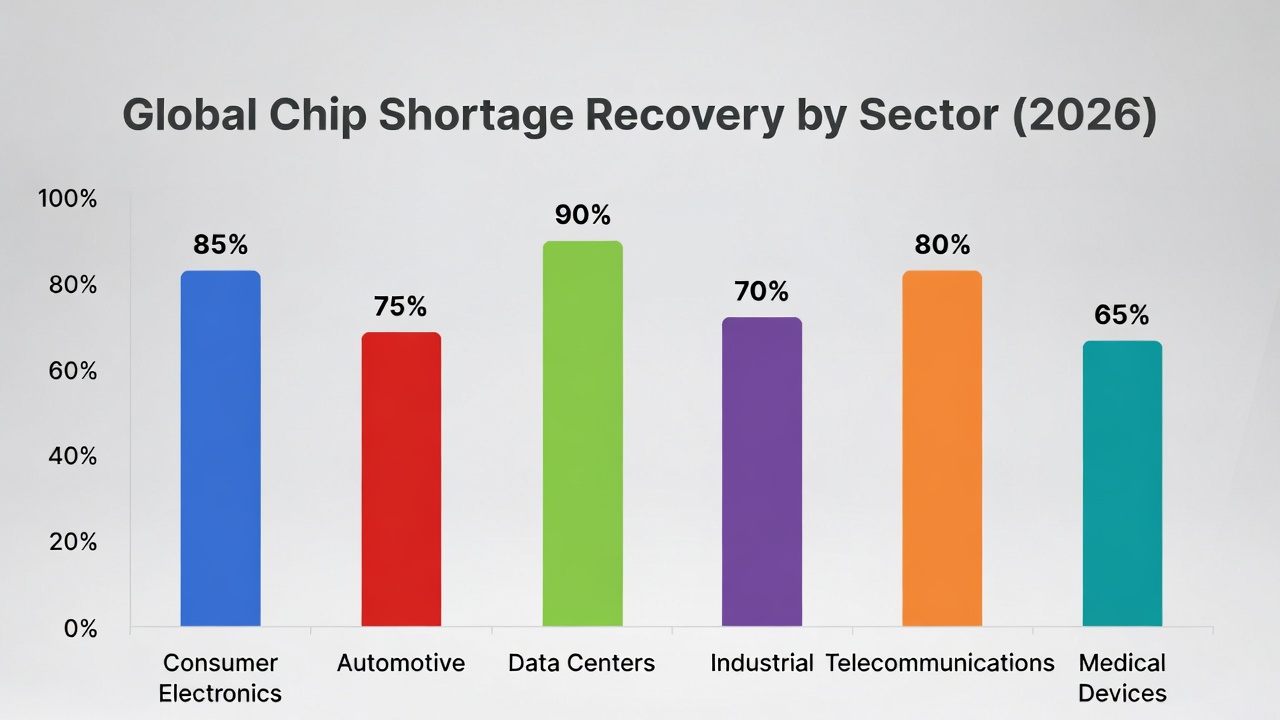
Not all industries are experiencing the same recovery trajectory when it comes to global chip shortage updates. Let me break down how various sectors are faring as we move through 2026, based on current market conditions and supply chain reports.
The smartphone industry has recovered most completely. Major manufacturers like Apple, Samsung, and Google have secured long-term supply agreements with fabrication plants, ensuring steady component flow. You’ll notice that flagship phones are readily available at launch, unlike the allocation systems that plagued 2021-2022 releases. Mid-range and budget devices have also seen improved availability, with prices returning to more reasonable levels.
Consumer laptops and desktop computers have similarly rebounded. The severe shortages of processors, memory chips, and storage components have largely resolved. However, premium ultrabooks with the latest generation processors occasionally face limited initial availability due to high demand for cutting-edge manufacturing capacity.
Gaming consoles and graphics cards have transitioned from extreme scarcity to healthy availability. The PlayStation 5, Xbox Series X, and high-end GPUs can now be purchased at or near manufacturer’s suggested retail prices without battling bots or paying scalper premiums. This represents one of the most dramatic turnarounds in recent global chip shortage updates.
The automotive industry continues navigating challenges despite overall improvement. While production has recovered from the severe disruptions of 2021-2022, the shift toward electric vehicles and advanced driver assistance systems requires different chip types than traditional vehicles. Legacy automakers sometimes struggle to secure the specialized power management and sensor chips needed for EV production, creating periodic bottlenecks.
Industrial and medical equipment sectors are experiencing the slowest recovery. These industries use specialized chips often manufactured in smaller volumes, and production capacity for these components hasn’t expanded as rapidly as consumer-focused semiconductors. Manufacturers in these sectors still report lead times of 26-52 weeks for certain critical components.
Smart Shopping Strategies in the Current Chip Market
Understanding global chip shortage updates helps you make strategic purchasing decisions, but knowing when and how to buy technology matters just as much. Let me share practical approaches I’ve developed through years of tracking semiconductor supply trends and helping others navigate tech purchases.
Timing your purchases around product launch cycles has become less critical than during peak shortage years, but it still matters for cutting-edge devices. If you want the absolute latest technology, expect to pay a premium and possibly face limited initial availability. Waiting 2-3 months after launch typically provides better pricing and availability without sacrificing much in terms of performance or features.
Consider previous-generation technology for significant savings without meaningful performance compromises. With chip supplies normalizing, retailers and manufacturers are aggressively pricing older inventory to make room for new models. A one-year-old flagship smartphone or laptop often delivers 95% of the performance at 60-70% of the price.
Pay attention to regional availability differences. Global chip shortage updates reveal that some regions receive priority allocation based on manufacturing locations and trade agreements. If you’re shopping for smart home devices or other connected products, checking multiple retailers across different regions can reveal surprising availability variations.
Build relationships with local retailers for hard-to-find items. While online shopping dominates, small electronics shops often have different supplier networks and can sometimes secure products that major chains can’t. This approach particularly helps when searching for specialized components or niche technology products.
Monitor manufacturer direct sales channels alongside third-party retailers. Companies like Apple, Dell, and Samsung often maintain better stock of their own products than distributors do, especially during high-demand periods. Signing up for stock notifications can give you a significant advantage for new releases or popular items.
Don’t overlook refurbished and certified pre-owned options. With improved availability of new products, the refurbished market has become incredibly competitive, offering excellent values on like-new devices with full warranties. This approach also supports sustainability while saving money.
The Role of AI and Emerging Technologies in Chip Demand
Recent global chip shortage updates increasingly focus on artificial intelligence’s impact on semiconductor demand. The AI boom has created entirely new categories of chip shortage while traditional categories recover. This trend fundamentally reshapes how we think about chip supply and demand dynamics moving forward.
Large language models, image generation tools, and other AI applications require massive computational power, primarily delivered through specialized graphics processors and AI accelerators. Companies building AI tools and chatbots are competing for limited supplies of high-end chips, driving prices up and creating allocation challenges reminiscent of the broader shortage’s peak years.
What does this mean for average consumers? Gaming graphics cards occasionally face tighter supplies as data centers buy up production capacity. However, manufacturers have responded by creating dedicated AI-focused chip lines, helping separate consumer and enterprise markets. NVIDIA’s separation of gaming and data center products exemplifies this strategy.
The Internet of Things continues driving demand for simpler, lower-cost chips produced on older manufacturing nodes. Smart home devices, wearables, and connected appliances each need semiconductors, and while individual devices use inexpensive chips, the sheer volume creates substantial aggregate demand. Fortunately, these older-node chips are manufactured at facilities with available capacity.
Quantum computing and other emerging technologies are beginning to impact semiconductor demand, though they remain niche compared to AI. As these technologies mature over the coming years, they’ll contribute to the complex supply-demand balance that generates future global chip shortage updates.
The automotive industry’s transition to software-defined vehicles creates unprecedented semiconductor content per vehicle. Modern cars contain 1,000-3,000 chips compared to 100-200 in vehicles from a decade ago. This multiplication factor means even modest vehicle production growth translates to massive chip demand increases.

Geopolitical Factors Shaping Future Chip Availability
Understanding global chip shortage updates requires examining the geopolitical landscape that increasingly influences semiconductor production and distribution. Trade policies, national security concerns, and economic competition between major powers have transformed chips from simple components into strategic assets.
The United States and China continue competing for semiconductor dominance, with each nation investing heavily in domestic production capacity. Export controls limit which advanced chipmaking equipment can be sold to Chinese manufacturers, while China aggressively funds its own semiconductor ecosystem to reduce dependence on foreign suppliers. These tensions create market inefficiencies and occasionally disrupt supply chains.
Taiwan remains the epicenter of advanced chip manufacturing, producing roughly 60% of the world’s semiconductors and over 90% of the most advanced chips. This concentration creates both economic advantages and geopolitical vulnerabilities. Recent global chip shortage updates frequently mention efforts to diversify production geographically, reducing this single-point-of-failure risk.
European nations have united behind aggressive semiconductor policies, aiming to produce 20% of global chips by 2030. Major fabrication plants under construction in Germany, France, and Italy will add significant capacity, though they won’t fully eliminate European dependence on Asian suppliers for cutting-edge components.
Trade agreements and tariffs directly impact chip pricing and availability. Changes in import duties, sanctions, or preferential trading arrangements can quickly alter which products are economically viable in different markets. Savvy consumers and businesses monitor these policy shifts when planning major technology investments.
National security considerations increasingly influence which chips can be used in critical infrastructure. Governments mandate domestic or ally-sourced semiconductors for sensitive applications, creating separate supply chains for defense, telecommunications, and other strategic sectors. This fragmentation adds complexity to global chip markets.
Expert Predictions: What’s Next for the Chip Industry
Looking beyond current global chip shortage updates, what can we expect for the remainder of 2026 and into 2027? Industry analysts and semiconductor executives offer cautiously optimistic projections, though several potential disruption scenarios remain worth monitoring.
Most experts predict continued supply growth outpacing demand growth through mid-2027, leading to price softening across many chip categories. This oversupply situation may seem counterintuitive after years of shortages, but it reflects the long lead times required to build new fabrication facilities. Plants funded during the shortage are now coming online, even as demand growth has moderated.
The transition to smaller process nodes will continue, with 3-nanometer and eventually 2-nanometer chips becoming mainstream in premium devices. This progression requires enormous capital investment and technical expertise, concentrating advanced manufacturing among just a few companies worldwide. Mobile devices will benefit most immediately from these efficiency improvements.
Artificial intelligence demand will likely remain the primary growth driver for high-end chips through 2027 and beyond. However, second-generation AI chips optimized specifically for inference workloads should help ease pressure on the most advanced manufacturing capacity, redistributing demand across different chip types and production facilities.
Climate change and environmental sustainability will increasingly influence semiconductor manufacturing. Chip production requires enormous amounts of water and energy, making it vulnerable to droughts, power shortages, and carbon pricing. Companies are investing in renewable energy and water recycling, but environmental constraints may occasionally impact production capacity.
Consolidation among semiconductor companies will probably accelerate, with smaller players struggling to afford the massive investments required for next-generation manufacturing. This consolidation could reduce competition but might also improve supply chain efficiency and long-term stability.
New manufacturing technologies like extreme ultraviolet lithography and gate-all-around transistors will enable continued performance improvements, but they also introduce new technical challenges and potential bottlenecks. Delays in these technology transitions could create temporary shortages for specific chip categories.

Practical Advice for Businesses Managing Chip Supply Chains
While consumer-focused global chip shortage updates dominate headlines, businesses face unique challenges managing semiconductor supply for their products and operations. Whether you run a startup developing voice assistants or manage procurement for an established manufacturer, strategic approaches to chip sourcing can make or break your business in 2026.
Establish direct relationships with semiconductor manufacturers rather than relying solely on distributors. During shortage periods, companies with direct allocations receive priority over those purchasing through intermediaries. This relationship-building takes time but provides crucial supply security during periods of constrained capacity.
Maintain strategic inventory buffers, even though it ties up capital. The just-in-time model proved disastrous during the shortage, and most successful companies now hold 3-6 months of component inventory. Yes, this increases working capital requirements, but it prevents far more expensive production stoppages.
Design products with component flexibility whenever possible. If your product can use chips from multiple manufacturers or different generations of the same chip family, you gain enormous supply chain flexibility. This approach requires more complex design and qualification processes but dramatically reduces vulnerability to single-component shortages.
Invest in supply chain visibility tools that track component availability and pricing across multiple suppliers. Real-time market intelligence helps you spot emerging shortages before they become critical, allowing proactive responses rather than reactive scrambling.
Consider strategic partnerships or joint ventures for critical components. If your business depends heavily on specific chips, collaborating with other companies that use the same components can increase your collective negotiating power with suppliers.
Participate in industry organizations and information-sharing networks. Global chip shortage updates often circulate through professional networks before becoming public knowledge, giving you valuable early warning of potential issues. Groups like SEMI and regional semiconductor associations provide excellent forums for staying informed.
Conclusion: Navigating the New Normal in Semiconductor Supply
The global chip shortage updates for 2026 tell a story of remarkable recovery and ongoing transformation. While the crisis atmosphere of 2020-2022 has passed, the semiconductor industry has fundamentally changed in ways that will shape technology availability and pricing for years to come.
For consumers, the key takeaway is cautious optimism. Most products are readily available at reasonable prices, though cutting-edge technology and AI-related components still face occasional constraints. Shopping strategically, considering previous-generation options, and staying informed about market conditions helps you get the best value for your technology investments.
Businesses must balance the improved supply situation with continued vigilance about potential disruptions. Geographic diversification, strategic inventory, and flexible product designs provide resilience against future shocks, whether they come from geopolitical tensions, natural disasters, or unexpected demand surges.
The semiconductor industry’s massive capacity expansion will likely lead to periodic oversupply situations, particularly in mature technology nodes. These cycles create opportunities for consumers and businesses willing to time their purchases strategically or adopt slightly older technology at significant discounts.
Looking ahead, artificial intelligence, electric vehicles, and the Internet of Things will drive continued demand growth, ensuring semiconductors remain strategically and economically critical. Staying informed through regular global chip shortage updates helps you anticipate trends and make smarter decisions in this rapidly evolving landscape.
Remember that chip markets are cyclical, and today’s abundance could become tomorrow’s shortage if demand unexpectedly surges or production faces disruptions. The lessons learned from recent years about supply chain resilience, strategic planning, and flexible thinking will remain valuable regardless of whether we face shortages or surplus in the future. For more insights on how technology trends impact your daily life, explore our coverage of emerging tech news and stay ahead of the curve.
🛒 Recommended Products for Semiconductor Technology
Based on the global chip shortage updates discussed in this article, we’ve curated a selection of top-rated tech products that deliver exceptional performance and value. These recommendations are carefully chosen to help you implement the solutions that best fit your needs and budget.





- Best Cheap Smartwatch Under $50
 Best Cheap Smartwatch Under $50: 5 Reliable Picks for 2026 By Sanso Uka If you’re hunting for the best… Read more: Best Cheap Smartwatch Under $50
 - Best Dash Cams of 2026
 Best Dash Cams of 2026: Top Picks for Every Driver and Budget By Wanderson Nogueira Martins Choosing the best… Read more: Best Dash Cams of 2026
 - How to Transfer Data to New Phone
 How to Transfer Data to a New Phone: A Step-by-Step Guide for 2026 By Sanso Uka Upgrading to a… Read more: How to Transfer Data to New Phone
 - Senior-Friendly Smartphones 2026
 Senior-Friendly Smartphones 2026: Best Overall Picks for Every Budget By Sanso Uka Senior-friendly smartphones in 2026 have come a… Read more: Senior-Friendly Smartphones 2026
 - Best Mechanical Keyboards in 2026
 Best Mechanical Keyboards in 2026 Best Mechanical Keyboards in 2026: Top Picks for Every Budget and Use Case By… Read more: Best Mechanical Keyboards in 2026
 - Best Monitor for Home Office 2026
 Best Monitor for Home Office 2026: Expert Picks & Buying Guide By Sanso Uka Your monitor is the window… Read more: Best Monitor for Home Office 2026
 - How to Extend Smartphone Battery Life
 How to Extend Smartphone Battery Life: 12 Practical Tips That Actually Work By Sanso Uka You unplugged your phone… Read more: How to Extend Smartphone Battery Life
 - Best E-Readers in 2026
 Best E-Readers in 2026: Which One Is Actually Worth Buying? Best E-Readers in 2026: Which One Is Actually Worth… Read more: Best E-Readers in 2026
 - Refurbished vs New Laptop
 Refurbished vs New Laptop: Which Should You Buy in 2026? By Sanso Uka When you’re in the market for… Read more: Refurbished vs New Laptop
 - Best Gaming Headsets Under $100
 Best Gaming Headsets Under $100 in 2026: Top Picks for Every Platform By Sanso Uka Finding the best gaming… Read more: Best Gaming Headsets Under $100
 - How Long Do Laptops Last
 How Long Do Laptops Really Last? A Practical Guide to Lifespan By Sanso Uka If you are shopping for… Read more: How Long Do Laptops Last
 - Best Portable Charger 2026
 Best Portable Charger in 2026: Top Power Banks for Every Budget and Use Case By Wanderson Nogueira Martins Finding… Read more: Best Portable Charger 2026