
Best Affordable 4K Monitors: Complete Buying Guide for 2026
Finding the best affordable 4K monitors doesn’t mean you have to sacrifice quality for price. I’ve spent years testing displays across different price ranges, and I can confidently say that 2026 has brought us incredible options that deliver stunning 4K resolution without breaking the bank. Whether you’re a content creator, gamer, or professional looking to upgrade your workspace, there’s a budget-friendly 4K monitor that fits your needs perfectly.
The landscape of 4K monitors has changed dramatically over the past few years. What used to cost over $1,000 can now be found for under $300, and the quality has improved significantly. You’re no longer stuck choosing between resolution and features—today’s affordable options often include HDR support, high refresh rates, and excellent color accuracy.
In this guide, I’ll walk you through everything you need to know about choosing an affordable 4K monitor, from understanding the key specifications to avoiding common pitfalls. You’ll discover which features actually matter, which you can skip to save money, and exactly what to look for when shopping. Let’s dive into finding your perfect display.

Why 4K Resolution Matters for Your Display
When I first upgraded to a 4K monitor three years ago, I was skeptical about whether I’d notice the difference. Within one hour of use, I was completely sold. The jump from 1080p to 4K isn’t just about numbers—it’s about how crisp text appears, how detailed images look, and how much more screen real estate you gain for multitasking.
A 4K monitor packs 3840 x 2160 pixels into the screen, which is exactly four times the resolution of a standard 1080p display. This means you’re getting 8.3 million pixels working together to create sharper images, smoother lines, and incredible detail. For professionals who work with photos, videos, or design, this resolution is transformative.
The benefits extend beyond creative work. I’ve found that reading documents, browsing websites, and even watching movies becomes noticeably more enjoyable. Text rendering is so sharp that it feels like reading printed material, which reduces eye strain during long work sessions. If you spend hours at your computer daily, this improvement in visual comfort is worth the investment alone.
What makes 2026 the perfect time to buy is that manufacturing costs have dropped significantly. Panel technology has matured, competition has increased, and economies of scale mean that the best affordable 4K monitors now offer features that were once reserved for premium models. You can genuinely get professional-grade visual quality without the professional-grade price tag.

Key Features to Look for in Budget 4K Monitors
Not all 4K monitors are created equal, especially in the affordable category. I’ve learned through trial and error which specifications actually impact your daily experience and which are just marketing fluff. Understanding these features helps you make a smart purchase decision.
The most critical factor after resolution is panel type. You’ll encounter three main options: IPS, VA, and TN panels. IPS panels offer the best color accuracy and viewing angles, making them ideal for creative work and general use. VA panels provide deeper blacks and better contrast ratios, which is fantastic for watching movies. TN panels are the most affordable but have limited viewing angles and color reproduction—I generally recommend avoiding these unless you’re on an extremely tight budget.
- Refresh Rate: Most affordable 4K monitors offer 60Hz, which is perfectly fine for productivity and content consumption. However, if you’re into gaming, look for 75Hz or higher. The difference between 60Hz and 144Hz is dramatic for fast-paced games, though higher refresh rates typically add $100-200 to the price.
- Response Time: This measures how quickly pixels change color, typically ranging from 1ms to 5ms. For general use, 5ms is completely adequate. Gamers should aim for 4ms or lower to minimize motion blur and ghosting during fast action sequences.
- HDR Support: High Dynamic Range enhances brightness and color range, but here’s the catch—many budget monitors advertise HDR without having the brightness levels to make it meaningful. True HDR requires at least 400 nits of brightness. If a monitor only reaches 250-300 nits, the HDR badge is mostly cosmetic.
- Connectivity Options: Make sure the monitor has HDMI 2.0 or DisplayPort 1.4 at minimum. These are essential for running 4K at 60Hz. HDMI 2.1 is becoming more common and supports higher refresh rates, but it’s not critical unless you’re gaming with the latest consoles or GPUs.
- Adjustability: This is often overlooked but incredibly important for comfort. Look for height adjustment, tilt, and swivel capabilities. Many budget monitors only offer tilt, which can lead to neck strain. A VESA mount compatibility gives you the option to use a third-party stand if needed.
I’ve found that prioritizing panel quality and connectivity over flashy features like RGB lighting or curved screens delivers better long-term satisfaction. A well-built monitor with an excellent IPS panel will serve you reliably for years, while gimmicky features lose their appeal quickly.
Color accuracy is another consideration that varies widely among affordable 4K monitors. Most budget options cover about 95-99% of the sRGB color space, which is perfectly adequate for everyday use. If you’re doing professional photo or video editing, you might want to invest in a colorimeter for calibration, which costs around $100-150 and works with any monitor.
Understanding the True Cost of Affordable 4K Monitors
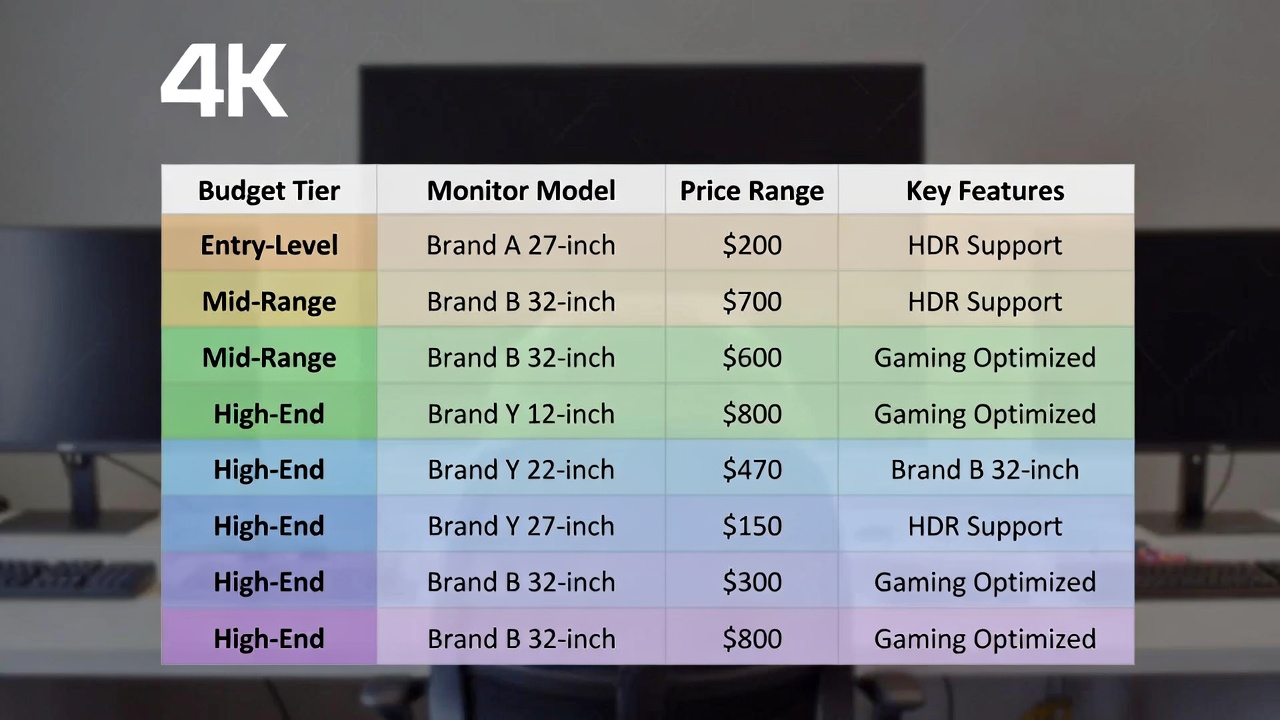
When we talk about affordable 4K monitors, what exactly does that mean in 2026? Based on current market conditions, I’d categorize them into three price tiers, each offering different value propositions.
The ultra-budget tier ranges from $200-300. These monitors typically feature 27-inch screens with basic IPS panels, 60Hz refresh rates, and minimal adjustability. They’re perfect for students, home office setups, or anyone upgrading from 1080p who primarily uses their computer for productivity, web browsing, and media consumption. Don’t expect premium color accuracy or lightning-fast response times, but you’ll get genuine 4K resolution that transforms your viewing experience.
The mid-range affordable tier sits between $300-500. This is the sweet spot where I usually recommend people invest. You’ll find 27-32 inch displays with better color gamut coverage, improved build quality, height-adjustable stands, and often 75Hz refresh rates. Some models in this range even include basic HDR support that’s actually functional. These monitors strike an excellent balance between price and performance.
The premium affordable tier caps out around $500-700. Here you’re getting features like true 144Hz refresh rates, USB-C connectivity with power delivery, factory color calibration, and robust construction. While still technically affordable compared to professional-grade monitors that cost $1,000+, these displays offer near-professional quality for serious enthusiasts who want the best without going bankrupt.
Beyond the monitor itself, consider the hidden costs. Your computer needs a capable graphics card to drive 4K resolution smoothly. For basic productivity, integrated graphics on modern processors work fine. For gaming or professional work, you’ll want a dedicated GPU with at least 4GB of VRAM. Also factor in proper cables—a quality DisplayPort or HDMI 2.0 cable costs $10-20 but ensures reliable signal transmission.
Common Mistakes When Buying Budget 4K Monitors
I’ve made my share of mistakes when hunting for affordable 4K monitors, and I’ve helped friends avoid many others. Learning from these experiences can save you both money and frustration.
The biggest mistake is prioritizing screen size over panel quality. A 32-inch monitor sounds impressive, but if it has a terrible TN panel with washed-out colors and awful viewing angles, you’ll regret it immediately. I always recommend a high-quality 27-inch IPS panel over a mediocre 32-inch display. The viewing experience matters far more than raw screen dimensions.
Another common error is ignoring pixel density considerations. At 27 inches, 4K provides approximately 163 pixels per inch, which is fantastic for sharp text and images. When you jump to 32 inches, that drops to around 138 PPI. While still good, the difference is noticeable. Some people prefer the larger workspace of 32 inches, but make sure you’re making an informed choice rather than just assuming bigger is better.
Many buyers fall for aggressive marketing around “gaming features” that don’t actually improve the gaming experience on budget monitors. Features like RGB lighting, elaborate OSD menus, and branded “gaming modes” add cost without meaningful performance benefits. Focus instead on refresh rate, response time, and input lag—these specifications actually impact gameplay.
Don’t overlook warranty and customer support. Some ultra-cheap brands offer rock-bottom prices but have virtually no customer service infrastructure. When a pixel starts malfunctioning or the backlight develops issues, you’ll wish you’d spent $30 more for a reputable brand with actual support. I recommend sticking with established manufacturers that have been in the display market for at least five years.
Finally, many people buy monitors without checking their computer’s capabilities first. If your laptop or desktop only has HDMI 1.4, you physically cannot output 4K at 60Hz—you’ll be stuck at 30Hz, which creates a choppy, unpleasant experience. Always verify your system’s video output specifications before purchasing. This five-minute check can prevent major disappointment.
Optimizing Your 4K Monitor Setup
Once you’ve selected the best affordable 4K monitor for your needs, proper setup ensures you get maximum value from your investment. I’ve fine-tuned my setup over the years and learned several tricks that significantly improve the experience.
Start with proper positioning. Your monitor should sit at arm’s length away, with the top of the screen at or slightly below eye level. This ergonomic positioning reduces neck strain during extended use. Because 4K displays show incredibly sharp text, you might be tempted to sit closer than with a 1080p monitor, but resist this urge—maintaining proper distance prevents eye fatigue.
Calibration makes a substantial difference even on budget displays. Windows and macOS both include built-in calibration tools that walk you through adjusting brightness, contrast, and color temperature. Spend 10 minutes with these tools, and you’ll notice immediate improvements in image quality. For serious color work, investing in a hardware calibrator like the X-Rite ColorChecker or Datacolor SpyderX provides professional-grade accuracy.
Scaling settings often confuse new 4K monitor owners. At native resolution, Windows’ default 150% scaling is usually ideal for 27-inch displays, while 125% works better for 32-inch screens. macOS handles this more automatically through its Retina-style scaling. Experiment to find what feels comfortable—there’s no single correct answer, and personal preference matters.
Lighting conditions dramatically impact your viewing experience. Position your monitor to avoid direct sunlight or bright windows in your line of sight, as glare ruins the 4K advantage. If you work in a bright room, look for monitors with anti-glare coatings. Conversely, if you work in dimmer environments, reduce your monitor’s brightness to around 30-40% to prevent eye strain—most monitors ship with brightness set far too high.
Cable management might seem trivial, but organized cables improve both aesthetics and functionality. Use the monitor’s built-in cable routing if available, or invest $10 in cable sleeves and clips. This prevents accidentally disconnecting cables and keeps your workspace tidy. When running cables, leave slight slack to allow for monitor adjustment without creating tension on the ports.

Gaming on Affordable 4K Monitors
Gaming at 4K resolution on a budget monitor is absolutely possible in 2026, but it requires realistic expectations and smart choices. I game regularly on an affordable 4K display, and understanding the tradeoffs helps you make the most of your setup.
The primary challenge is hardware requirements. Running modern games at native 4K resolution demands significant GPU power. A mid-range graphics card like the NVIDIA RTX 4060 or AMD RX 7600 can handle less demanding titles or older games at 4K, but you’ll need to adjust settings for the latest AAA releases. Many gamers use a hybrid approach—running competitive multiplayer games at 1440p for higher framerates while enjoying single-player adventures at full 4K.
Refresh rate matters tremendously for gaming. While 60Hz is smooth enough for most single-player games, competitive shooters and fast-paced action games benefit enormously from 144Hz or higher. The good news is that several affordable 4K monitors now offer 75Hz, which provides a noticeable improvement over 60Hz without the premium price tag of true high-refresh displays.
Input lag is another critical specification that budget monitor manufacturers sometimes neglect to advertise. Anything under 10ms is excellent for gaming, while 15-20ms is acceptable. Beyond 20ms, you’ll start noticing a disconnect between your actions and on-screen response, especially in competitive games. Check professional reviews for input lag measurements, as manufacturers rarely list this specification honestly.
Variable refresh rate technology like AMD FreeSync or NVIDIA G-Sync Compatible makes a huge difference in gaming smoothness. Most affordable 4K monitors in 2026 include FreeSync support, which works with both AMD and modern NVIDIA cards. This technology eliminates screen tearing and stuttering, creating a much more polished gaming experience even when framerates fluctuate.
Consider the genre of games you play most. If you’re primarily into turn-based strategy, RPGs, or simulation games, a beautiful 4K IPS panel at 60Hz provides an incredible visual upgrade. For competitive esports titles where every millisecond matters, you might actually prefer a 1440p 144Hz monitor over a 4K 60Hz display. There’s no wrong answer—it depends entirely on your gaming priorities and preferences.
Professional Work on Budget 4K Displays
You don’t need a $2,000 professional monitor to do professional work. I’ve edited videos, designed graphics, and written extensively on affordable 4K monitors, and the results have been excellent when you choose wisely and work within the display’s capabilities.
For photo editing, color accuracy is paramount. Most affordable 4K monitors cover 95-99% of sRGB, which is sufficient for web-based work and general photography. If you’re preparing images for print or working in Adobe RGB, you’ll need to be more selective. Look for monitors specifically advertising wide color gamut support, typically starting around $400. The investment pays off in color fidelity that matches your final output.
Video editors benefit immensely from 4K resolution because you can view full HD timelines at native resolution with plenty of room for toolbars and panels. I edit 4K footage on my affordable monitor and appreciate seeing every detail without scaling. The caveat is ensuring your monitor’s color accuracy is consistent—some budget panels have color shift across different areas of the screen, which can cause editing mistakes.
Programmers and developers find that 4K displays transform their workflow. You can comfortably view code on one half of the screen while documentation or testing occupies the other half, all while maintaining readability. The pixel density means you can reduce font sizes without sacrificing clarity, fitting more code on screen simultaneously. This efficiency boost alone justifies the upgrade cost.
Content creators working with multiple applications simultaneously appreciate the screen real estate that 4K provides. I regularly have email, web browsers, design tools, and communication apps open together without feeling cramped. Windows’ Snap feature combined with 4K resolution creates a virtual multi-monitor setup on a single display, reducing desk clutter while maintaining productivity.
The one area where affordable monitors sometimes fall short for professional work is uniformity. Premium displays maintain consistent brightness and color across the entire panel, while budget options may show slight variations, especially in the corners. For critical color work, test your monitor with uniformity images and understand any limitations. Most of the time, these variations are subtle and don’t impact everyday professional work.

Future-Proofing Your Monitor Investment
When spending several hundred dollars on a monitor, you want it to remain relevant and useful for years. The good news is that display technology evolves more slowly than other computer components, making monitors excellent long-term investments when chosen carefully.
Connectivity options are crucial for longevity. Ensure your affordable 4K monitor includes both HDMI 2.0 and DisplayPort 1.4 at minimum. HDMI 2.1 support is a bonus that provides compatibility with the latest gaming consoles and future graphics cards. USB-C with DisplayPort Alt Mode is becoming increasingly common and incredibly convenient for laptop users, allowing single-cable connection for video, data, and charging.
Panel longevity varies, but most modern LCD panels maintain 90% or more of their original brightness after 30,000-50,000 hours of use. At 8 hours per day, that’s over 10 years of service life. The components more likely to fail are power supplies and control electronics, which is why purchasing from manufacturers with good warranty support matters. A 3-year warranty is standard; some brands offer 5 years on higher-end models.
Consider how display standards might evolve. While 8K monitors exist, they’re prohibitively expensive and unnecessary for most users in 2026. 4K will remain the standard for desktop computing for the foreseeable future, just as 1080p remained relevant for over a decade. Your affordable 4K monitor purchase should serve you well until at least 2030 without feeling outdated.
Adaptive sync technology ensures your monitor stays compatible with both current and future graphics cards. FreeSync support is nearly universal on affordable 4K monitors and works with AMD, NVIDIA, and even integrated graphics from Intel and AMD. This compatibility means you can upgrade your computer components without worrying about monitor compatibility issues.
Think about your potential needs three to five years from now. If you might transition to content creation, prioritize color accuracy even if you’re primarily gaming now. If you might add a second monitor later, consider how they’ll work together—matching sizes and panel types creates a more cohesive multi-monitor setup. Planning ahead prevents the need to replace your monitor prematurely when your needs evolve.
Conclusion
Choosing the best affordable 4K monitors in 2026 means balancing resolution, features, and budget to find your perfect display. Whether you’re spending $250 on your first 4K upgrade or investing $600 in a feature-rich model, the technology has matured to the point where you can get exceptional visual quality without premium pricing.
Remember that the most expensive affordable option isn’t always the best choice for your specific needs. A well-chosen $350 monitor that matches your primary use case will provide more satisfaction than a $650 model packed with features you’ll never use. Focus on panel quality, proper specifications for your workflow, and reputable manufacturers with solid warranties.
Take your time researching, read professional reviews beyond just user ratings, and don’t hesitate to visit a store to see monitors in person if possible. The difference between specifications on paper and real-world visual quality can be surprising. Your monitor is something you’ll interact with every single day, making it one of the most important components in your entire setup. Choose wisely, and you’ll enjoy years of stunning 4K visuals that enhance everything you do on your computer.
🛒 Recommended Products for Best Affordable 4K Monitors
Based on the best affordable 4K monitors discussed in this article, we’ve curated a selection of top-rated products that deliver exceptional performance and value. These recommendations are carefully chosen to help you implement the solutions that best fit your needs and budget.





- Best Cheap Smartwatch Under $50
 Best Cheap Smartwatch Under $50: 5 Reliable Picks for 2026 By Sanso Uka If you’re hunting for the best cheap smartwatch under $50, you probably expect to sacrifice features like… Read more: Best Cheap Smartwatch Under $50
 - Best Dash Cams of 2026
 Best Dash Cams of 2026: Top Picks for Every Driver and Budget By Wanderson Nogueira Martins Choosing the best dash cam in 2026 means navigating a market that has improved… Read more: Best Dash Cams of 2026
 - How to Transfer Data to New Phone
 How to Transfer Data to a New Phone: A Step-by-Step Guide for 2026 By Sanso Uka Upgrading to a new smartphone is exciting, but the thought of moving all your… Read more: How to Transfer Data to New Phone
 - Senior-Friendly Smartphones 2026
 Senior-Friendly Smartphones 2026: Best Overall Picks for Every Budget By Sanso Uka Senior-friendly smartphones in 2026 have come a long way from the oversimplified “big button” phones of a decade… Read more: Senior-Friendly Smartphones 2026
 - Best Mechanical Keyboards in 2026
 Best Mechanical Keyboards in 2026 Best Mechanical Keyboards in 2026: Top Picks for Every Budget and Use Case By Sanso Uka Finding the best mechanical keyboard in 2026 means navigating… Read more: Best Mechanical Keyboards in 2026
 - Best Monitor for Home Office 2026
 Best Monitor for Home Office 2026: Expert Picks & Buying Guide By Sanso Uka Your monitor is the window to your digital work life—spend eight hours staring at a mediocre… Read more: Best Monitor for Home Office 2026
 - How to Extend Smartphone Battery Life
 How to Extend Smartphone Battery Life: 12 Practical Tips That Actually Work By Sanso Uka You unplugged your phone at 8 AM, and by 2 PM you’re hunting for a… Read more: How to Extend Smartphone Battery Life
 - Best E-Readers in 2026
 Best E-Readers in 2026: Which One Is Actually Worth Buying? Best E-Readers in 2026: Which One Is Actually Worth Buying? By Sanso Uka If you’re looking for the best e-reader… Read more: Best E-Readers in 2026
 - Refurbished vs New Laptop
 Refurbished vs New Laptop: Which Should You Buy in 2026? By Sanso Uka When you’re in the market for a laptop, the first fork in the road is choosing between… Read more: Refurbished vs New Laptop